
Building Enterprise Context Pipelines: Retrieval, Orchestration, and …
Source: hackernoon.com
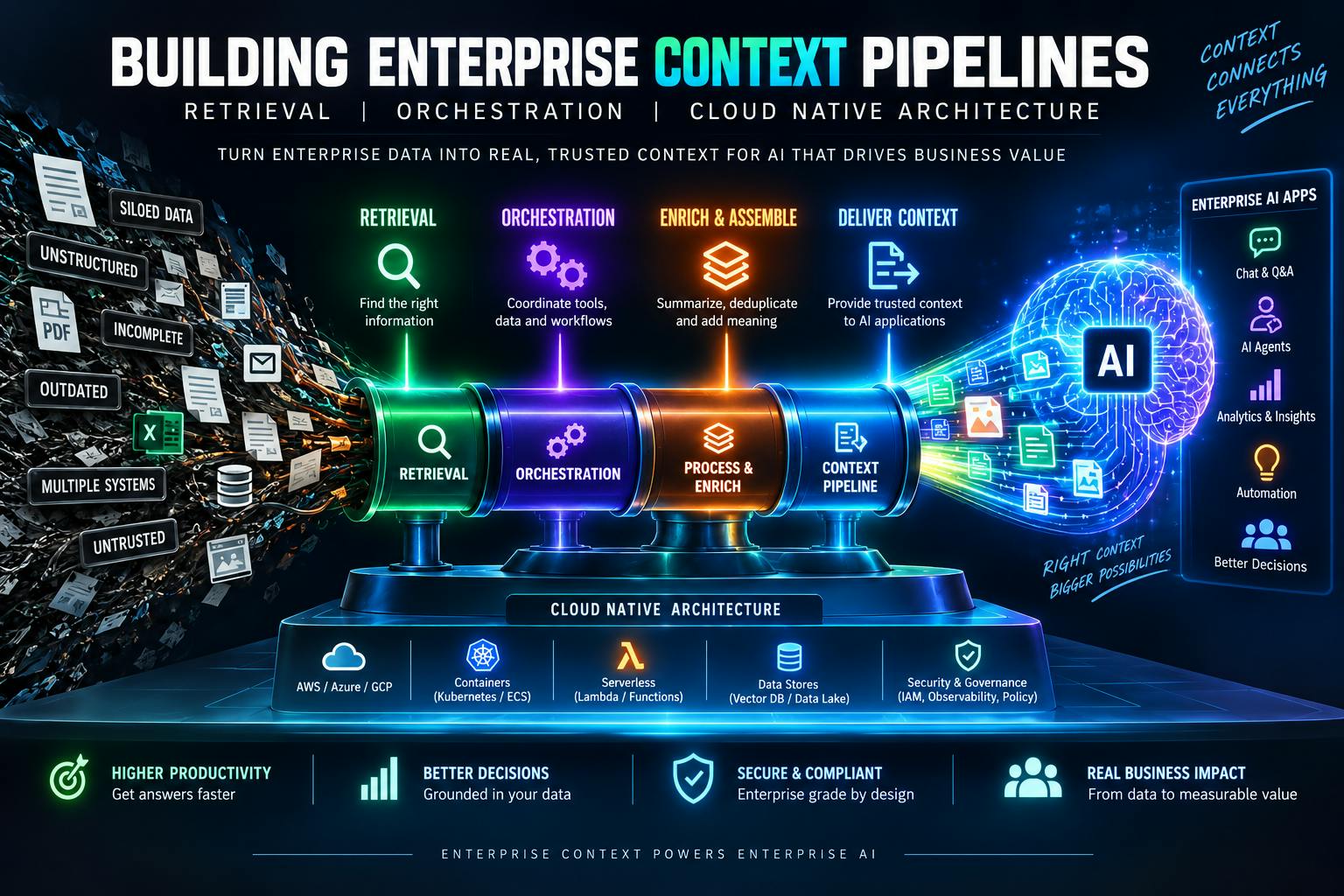
A context pipeline is the system that decides what information reaches an AI model, in what form, and under what controls, for every request at enterprise scale. Enterprise knowledge is spread across structured databases, documents and files, APIs, application logs, user interactions, knowledge repositories, and IoT and event streams, each requiring a different retrieval strategy. The pipeline turns raw data into a response through a repeatable sequence of steps: retrieval, ranking, filtering, deduplication, summarization, compression, access control, and prompt assembly. Context window limits make optimization a first-class design concern, and vector databases and knowledge graphs solve different problems, with many enterprise systems needing both. The Model Context Protocol (MCP) gives AI systems a standard, governed way to reach live tools and data. On AWS, Amazon S3 provides scalable, secure storage for documents, datasets, and unstructured content; Amazon Aurora and Amazon DynamoDB serve structured and transactional data with low latency; Amazon OpenSearch Service handles semantic and keyword retrieval over indexed content; and AWS Lambda runs the logic that fetches data from APIs and other systems on demand.
SUCKS 0
0
0
Comments
This page shows all existing comments. To add a new comment, open the post in the forum.
No comments yet.