
Managing AI Coding Costs at Scale
Source: databricks.com
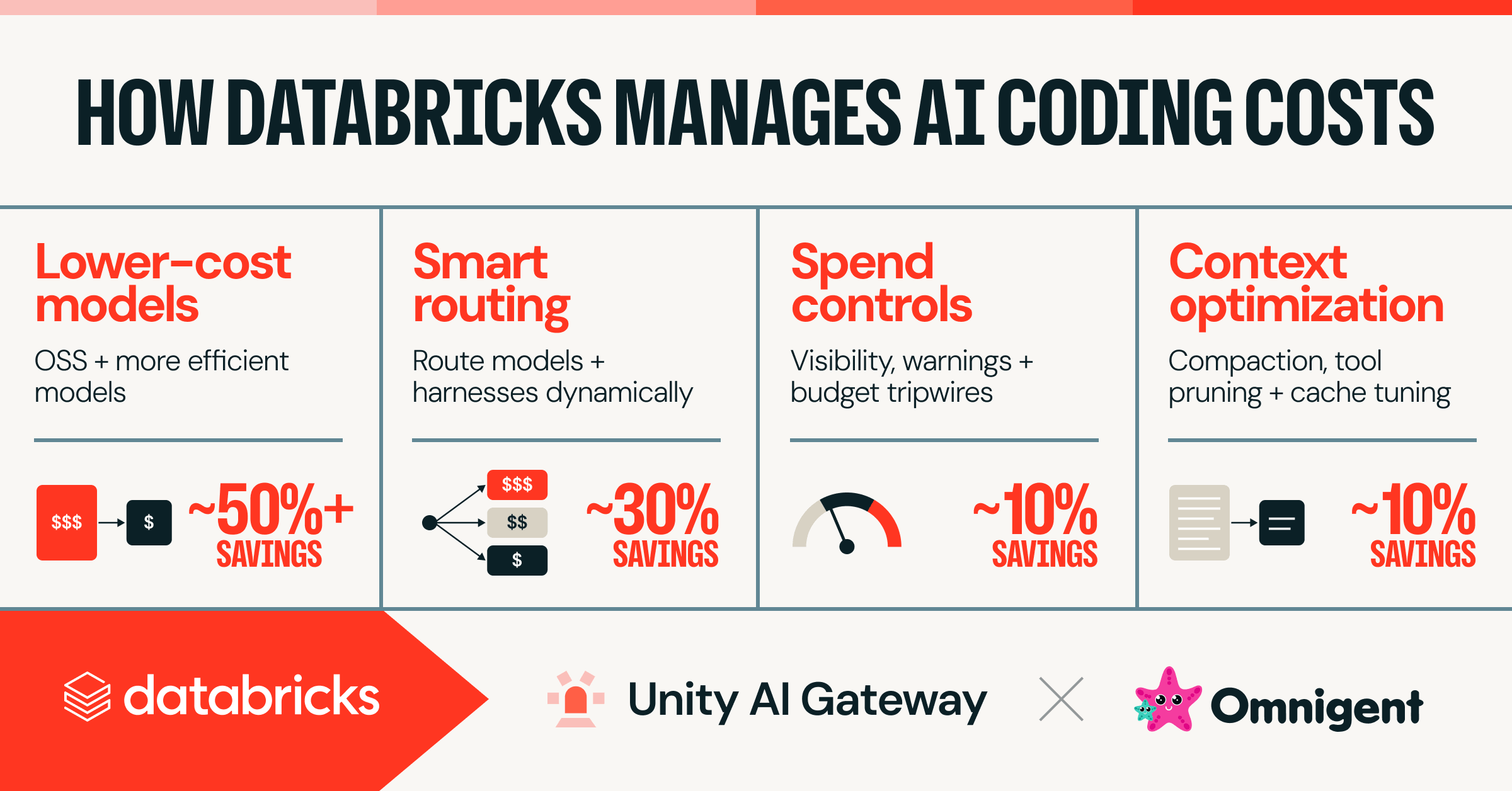
At Databricks, agentic coding has measurably improved every velocity metric tracked and, in some teams, driven order-of-magnitude gains in output, but nearly every company deploying AI tools at scale faces exponentially growing costs that are unsustainable and could overtake revenue. Early large-scale adopters have converged on approaches achieving a “dual mandate”: providing broad access to AI tooling with minimal friction while keeping aggregate costs inside a roughly fixed envelope per user. This post outlines proven cost management techniques based on Databricks’ experience and conversations with Stripe, Coinbase, Uber, and Ramp. The single greatest cost lever is moving coding spend to more efficient models as they are released, as the efficiency frontier—models with the best price for a given intelligence level—is advancing far faster than the intelligence frontier, with new models released almost weekly offering better intelligence-per-unit-price. Most day-to-day coding does not require mathematical proofs or novel security insights, so aggregate cost depends on models meeting the quality bar for typical software engineering work. Some techniques are easily implemented with existing software, while others require new infrastructure, particularly those modifying end-user clients or shifting traffic across models. Databricks has open sourced its key infrastructure components: an end user meta-harness (Omnigent) and its AI Gateway (Unity AI Gateway).
SUCKS 0
0
0
Comments
This page shows all existing comments. To add a new comment, open the post in the forum.
No comments yet.