
Researchers Use AI to Make Quantum Circuit Tuning Less Trial And Error
Source: thequantuminsider.com
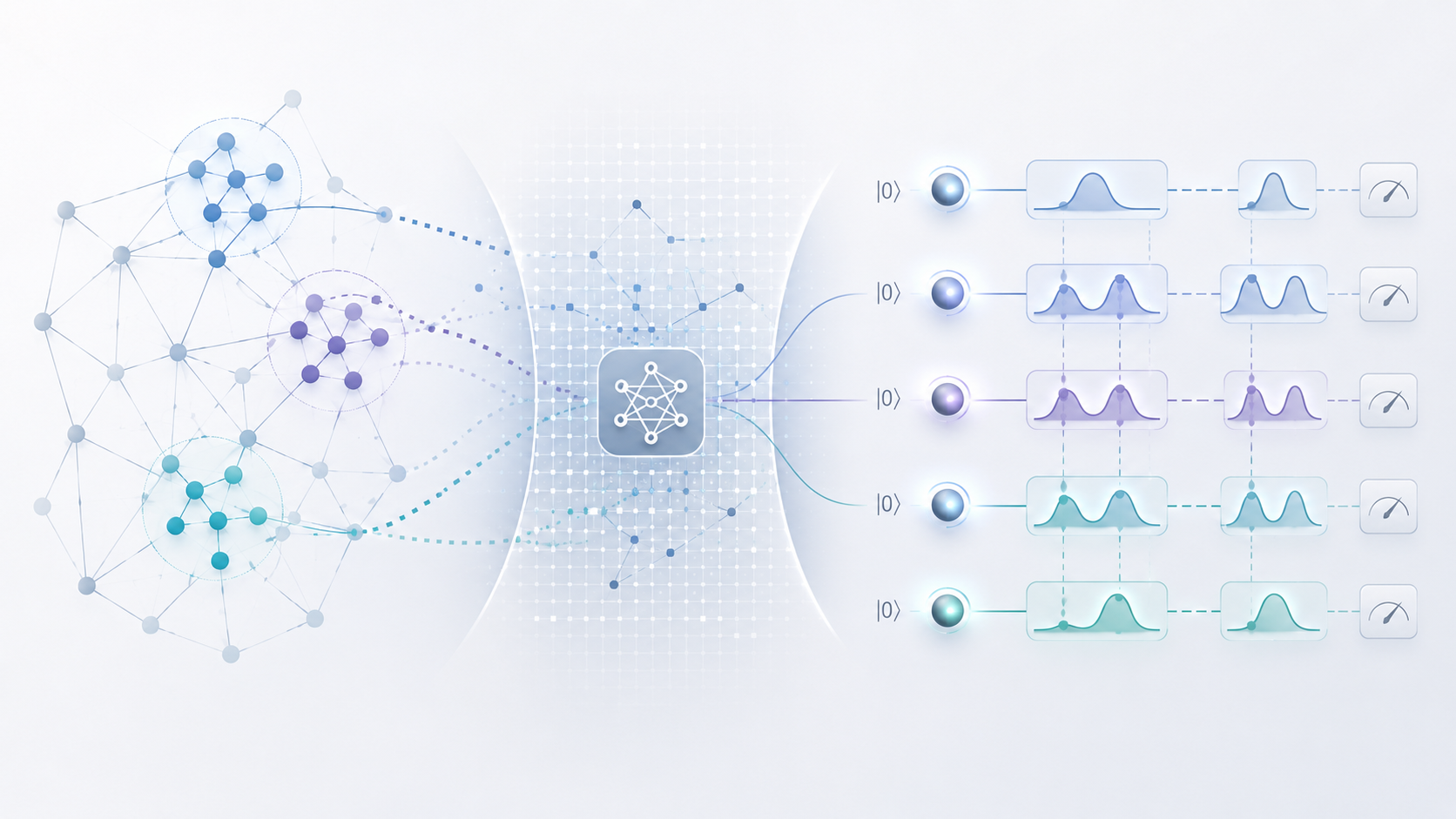
Researchers from Texas A&M University, NVIDIA and Los Alamos National Laboratory developed an AI-assisted framework to identify patterns in quantum circuit behavior and reduce trial-and-error tuning. The system combines CUDA-Q simulations, automated conjecture generation and LLM-based interpretation to connect QAOA parameters with graph features in MaxCut problems. The study, posted to arXiv, introduces SCALAR — short for Symbolic Conjecture and LLM-Assisted Reasoning — a system designed to study quantum circuits by combining simulation, automated mathematical conjecture generation and large language model (LLM) interpretation. The team tested the framework on the Quantum Approximate Optimization Algorithm, or QAOA, a widely studied method for using quantum computers to attack optimization problems. The researchers found that, for some low-depth QAOA circuits, the best algorithm settings could often be predicted from a small set of graph features. The study found that low-depth QAOA settings were often predictable from a small set of graph invariants, though the pattern weakened for deeper circuits and broader graph families. The work describes SCALAR as an early step toward automated reasoning about quantum circuit behavior, rather than another tool for merely building or compiling quantum circuits.
SUCKS 0
0
0
Comments
This page shows all existing comments. To add a new comment, open the post in the forum.
No comments yet.