
Nanoscale Electrochemical Sensors and Machine Learning Advance Real-T…
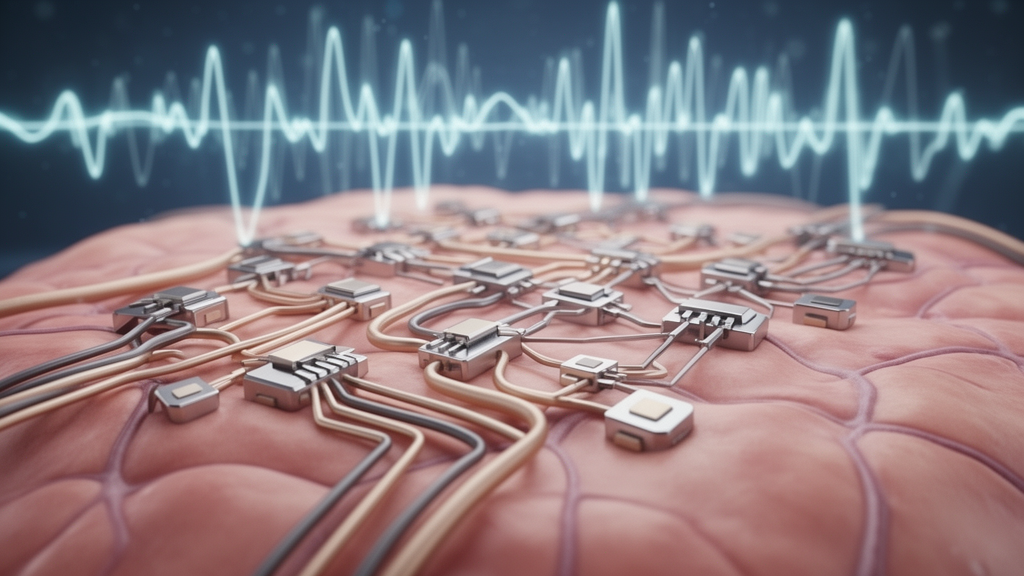
Source: bioengineer.org
Researchers outline in QRB Discovery how breakthroughs in micro- and nanoelectrode engineering and machine learning over the past decade provide opportunities for tracking brain chemistry in real time, noting that electrochemical techniques offer subsecond temporal resolution, operate without genetic modification, and can be miniaturized into implantable micro- and nanoelectrodes, while label-free biosensors such as enzyme microelectrodes and aptamer field-effect transistors push detection limits into the low-picomolar range. A major advance is single-vesicle electrochemistry, resolving exocytotic kinetics; single-cell amperometry directly detects monoamines released during exocytosis, and intracellular vesicle impact electrochemical cytometry, developed by Ewing’s group, allows quantification of neurotransmitter content inside individual vesicles. Studies combining both techniques show exocytosis often releases only a fraction of stored transmitters: in Drosophila type II neuromuscular neurons, simple fusion events release less than five percent of vesicular octopamine content, while flickering-pore events release nearly eleven percent, far below the sixty percent released in PC12 and chromaffin models, and mathematical modeling predicted transmitter release across four pore dynamics modes. Zhu and colleagues demonstrated that alpha-synuclein overexpression in neurons and midbrain organoids from young-onset Parkinson’s disease patients impairs vesicular dopamine storage. Combining the techniques has also clarified vesicular release patterns for serotonin; in Drosophila larvae ventral nerve cords, Gu and colleagues discovered serotonin exocytotic events follow a bimodal Gaussian distribution, featuring small-am
SUCKS 0
0
0
Comments
This page shows all existing comments. To add a new comment, open the post in the forum.
No comments yet.