
Artificial Intelligence in Nuclear Medicine (2015-2025): Clinical App…
Source: cureus.com
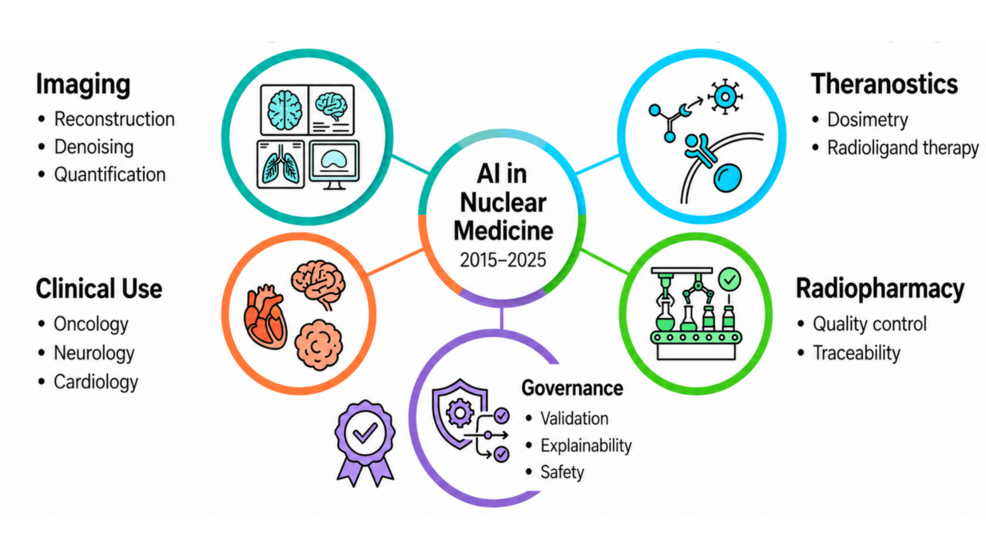
Based solely on the provided article body, artificial intelligence (AI), particularly machine learning and deep learning, has emerged to address challenges in nuclear medicine related to standardization, reproducibility, and access. Neural network architectures like convolutional neural networks (CNNs), encoder-decoder models, U-Net-derived architectures, and generative adversarial networks (GANs) have been applied to image reconstruction, denoising, lesion segmentation, quantitative harmonization, and dose estimation. Radiomics has expanded the analytic value of PET and SPECT by enabling systematic extraction of quantitative image features. AI applications now extend beyond image processing to include AI-supported radiopharmacy workflows, such as radiochemical synthesis optimization, quality control assistance, and inventory-related planning. AI has also been evaluated in theranostic pathways for quantitative imaging, time-activity modeling, absorbed-dose estimation, and individualized dosimetry for radioligand therapy planning. These developments have direct implications for radiopharmacists and hospital pharmacists whose responsibilities intersect with radiopharmaceutical preparation, verification, traceability, quality assurance, and dosimetric interpretation.
SUCKS 0
0
0
Comments
This page shows all existing comments. To add a new comment, open the post in the forum.
No comments yet.