
Spatial Skip-Connected Attention Model Accurately Predicts Urban Traf…
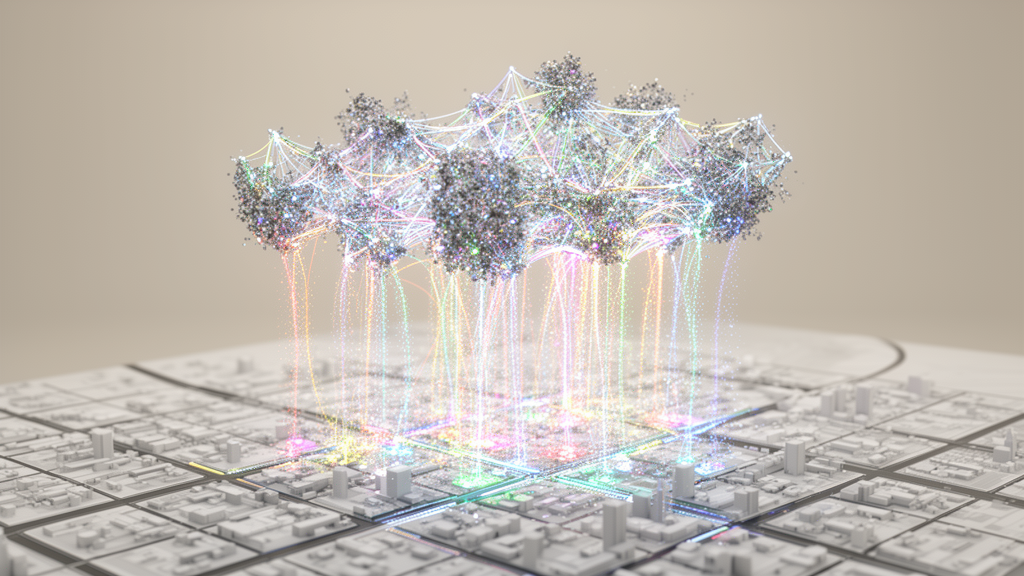
Source: bioengineer.org
A newly developed deep learning architecture named the Spatial Skip-Connected Attention-based Long Short-Term Memory framework achieves high predictive accuracy in forecasting urban traffic congestion intensity by integrating environmental air quality measurements as auxiliary predictors. In empirical evaluations using the benchmark CityPulse EU FP7 dataset, the architecture attained a Mean Square Error of 0.3310 and a Coefficient of Determination of 0.927, outperforming established recurrent networks, hybrid architectures, and spatial graph models. Designed by researchers Vishwanath Bidare Ranganath, Sanjay Shekar Nagenahalli Chandrashekar, and Miguel Garcia-Torres, the framework formulates a spatially conditioned temporal memory mechanism that couples hierarchical multiscale spatial learning with recurrent sequence modeling. Rather than depending exclusively on dedicated vehicular sensing hardware, which is frequently prone to hardware disruptions or spatial deployment constraints, the system demonstrates that atmospheric pollutant dynamics provide informative analytical proxies for evolving congestion conditions across complex metropolitan environments. Because internal combustion vehicular activity represents a primary contributor to localized emissions of carbon monoxide and nitrogen dioxide, ambient atmospheric monitoring stations capture indirect signatures of traffic congestion. Utilizing atmospheric air quality parameters as auxiliary indicators provides an opportunity to support congestion-aware municipal decision support systems, mitigate municipal infrastructure installation expenses, reduce operational power consumption, and provide resilient backup telemetry when conventional traffic counter loops experience hardware malfunction. The experimental corpus spans six consecutive months and incorporates 17,568 synchronized records captured at uniform five-minute sampling intervals across 449 observation points throughout the urban grid.
SUCKS 0
0
0
Comments
This page shows all existing comments. To add a new comment, open the post in the forum.
No comments yet.