
Light Flips Memory to Feed Hungry AI Chips With Less Energy
Source: spectrum.ieee.org
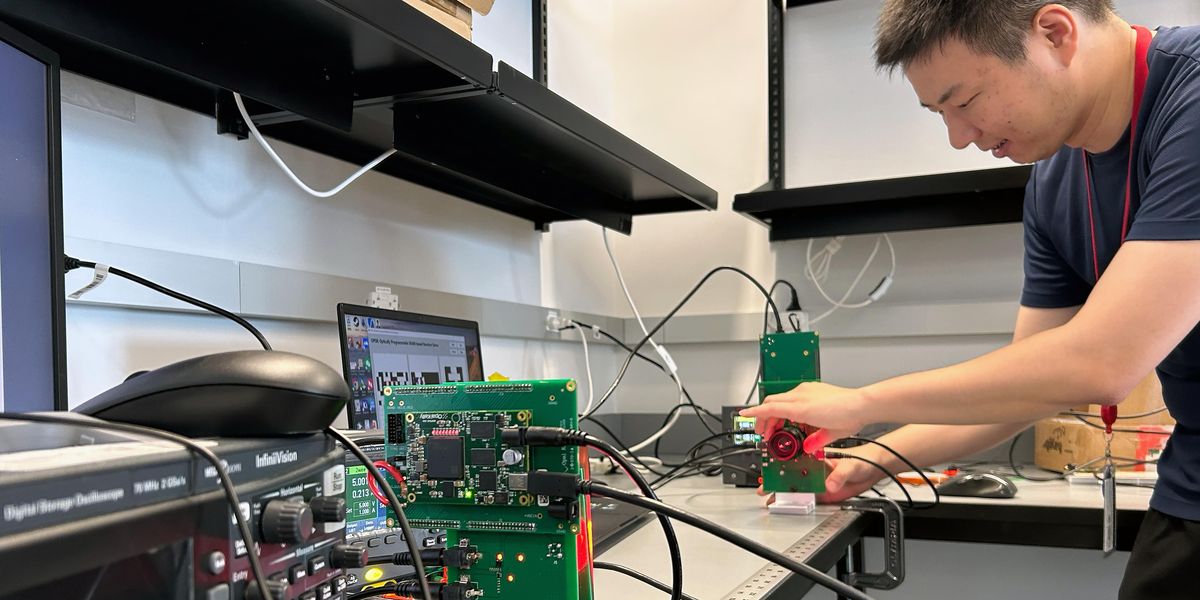
A new optical receiver design, presented last month at the IEEE/JSAP Symposium on VLSI Technology & Circuits by Cornell Tech researchers, aims to reduce energy demands for AI systems by directly altering memory using photocurrents from beamed light. Postdoctoral researcher Yifan He demonstrated the device, which uses an LED emitting red light to beam QR-code-like matrices to a receiver nearly a meter away. Unlike standard optical receivers that rely on power-hungry analog circuits to convert light to electronic bits, this new technology enables fully digital optical communication by receiving rapid flashes of digital matrices, allowing chips to tweak AI model parameters without those circuits. The approach seeks to lower energy typically required for data centers, self-driving cars, and edge applications like AI-powered robots. Jae-sun Seo, an associate professor of electrical and computer engineering at Cornell Tech, noted that AI chips often lack room for all model parameters, so additional data is stored in dynamic random-access memory (DRAM), and electrical connections moving data between DRAM and the processor create cost and efficiency bottlenecks. In the new system, DRAM sits with the transmitter, while the receiver is part of the processor’s static random-access memory (SRAM), modified to contain photodiodes.
SUCKS 0
0
0
Comments
This page shows all existing comments. To add a new comment, open the post in the forum.
No comments yet.