
OpenAI and perplexity, the yardstick to limit AI
Source: meteoraweb.com
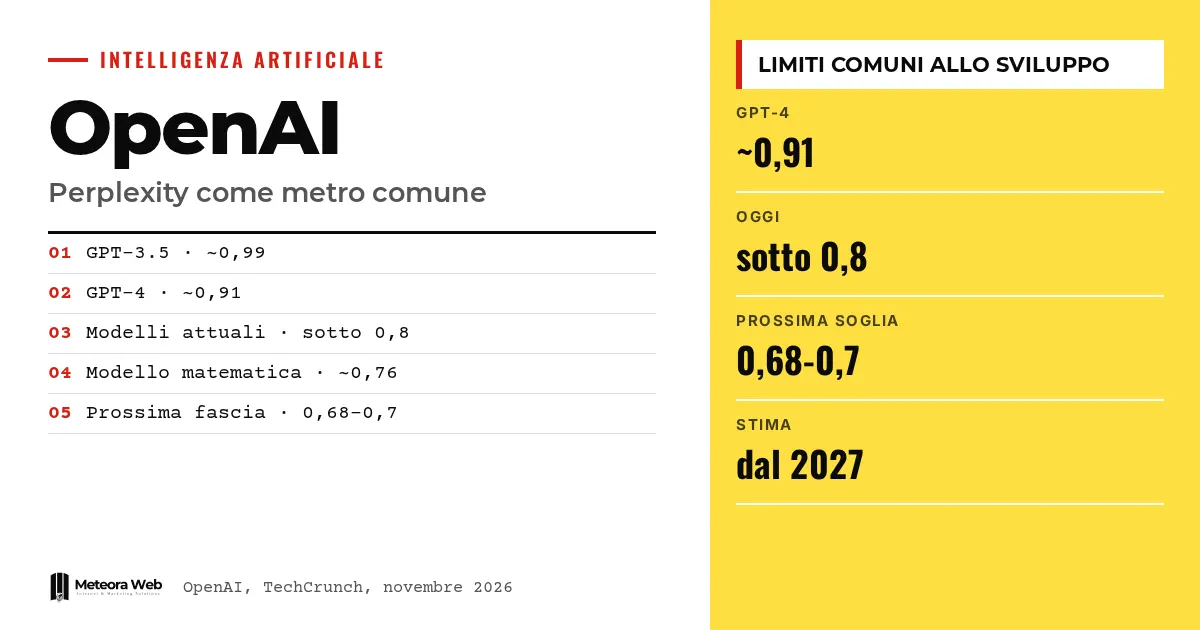
Jakub Pachocki, chief scientist at OpenAI, has published a post proposing to use perplexity as a common measure of progress in artificial intelligence, tying it to shared limits across labs that would not be exceeded until controls are ready; Sam Altman called it «the most important thing OpenAI has published in a while». Perplexity is a measure of how well a model predicts the next token, on average—the lower it is, the better the predictions—and cross-entropy loss is an equivalent way of expressing the same value. Pachocki argues perplexity could become a shared reference among developers, with «common limits» based on this and other measures that companies would commit not to exceed until the ability to understand and monitor AI behavior reaches a concrete milestone, one example being a successor to chain-of-thought monitors; as Punto Informatico notes, it would not be a stop but a traffic light, switching off once the controls are ready. He says benchmarks on concrete capabilities age quickly and those used in the past were largely saturated around GPT-4, while perplexity remains informative over time because new capabilities emerge mainly from progress in data compression. OpenAI declares log-perplexity values on its main evaluation dataset—company figures not verified by third parties: GPT-3.5, about 0.99; GPT-4, about 0.91; below 0.8, transformative capabilities in cybersecurity and mathematics; about 0.76, the model that would have
SUCKS 0
0
0
Comments
This page shows all existing comments. To add a new comment, open the post in the forum.
No comments yet.