
To Build More Believable Bots, Simulate The Neurochemistry
Source: hackaday.com
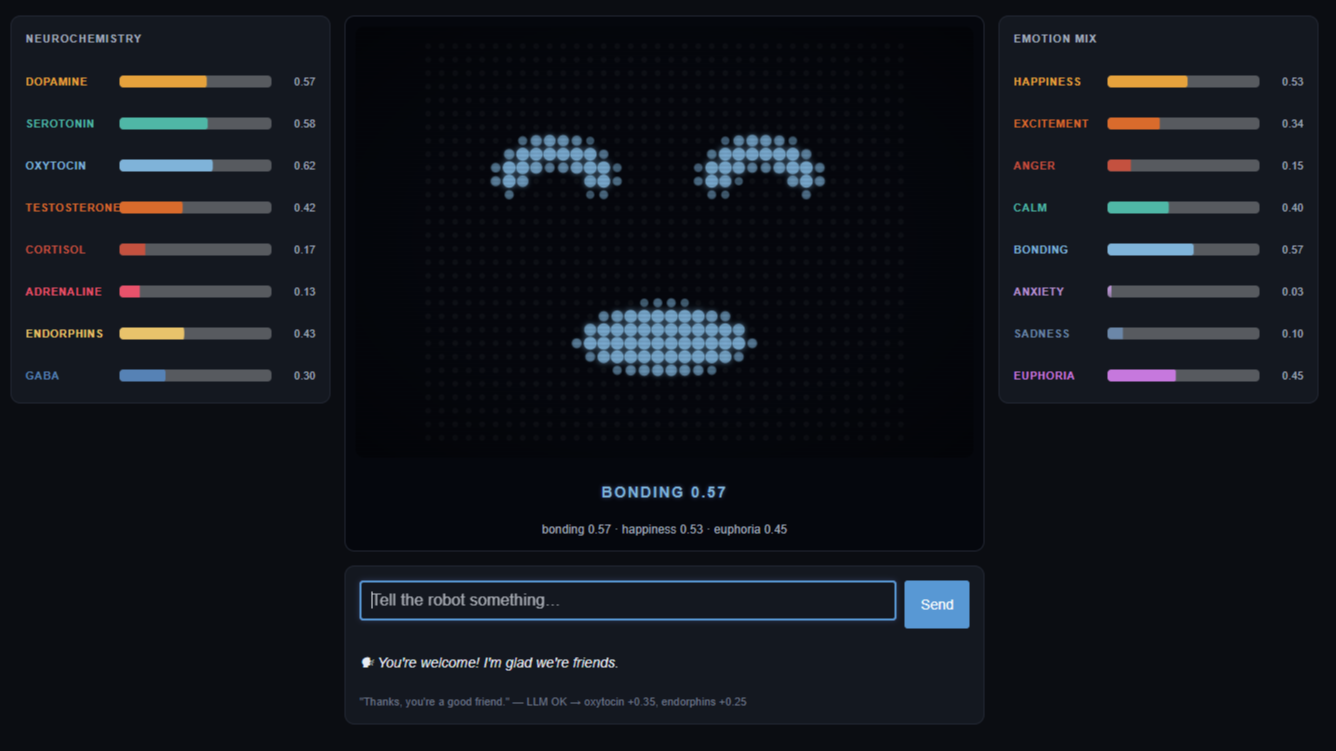
[Drew Smith]’s project Kindalive is a simulated dot-matrix robot face that responds believably to input text by modeling both short-term and long-term moods. It is pure Python and modular, but its key innovation is modeling eight key neurochemicals (including dopamine and cortisol) as the foundation from which to derive emotional states. Unlike conventional sentiment analysis that uses a large language model (LLM) to apply discrete labels, Kindalive models the decay and interplay between its simulated neurochemicals to derive emotional states on the fly. Physical representation of the emotional mix is done by altering twelve key facial movements (brow raise, lip corner pull, mouth open, and others) known as the Facial Action Coding System (FACS). These twelve elements combine to express emotion nonverbally with facial expressions, driving the simulated dot-matrix robot face and potentially a real LED matrix or servos on an animatronic face. The article notes that much of communication is nonverbal, and humans weigh nonverbal higher when there is a mismatch between verbal and nonverbal content, giving clear value to robots that can express themselves nonverbally.
SUCKS 0
0
0
Comments
This page shows all existing comments. To add a new comment, open the post in the forum.
No comments yet.