
New 56% Benchmark in Figure Triggers Critical Generalization Verifica…
Source: eu.36kr.com
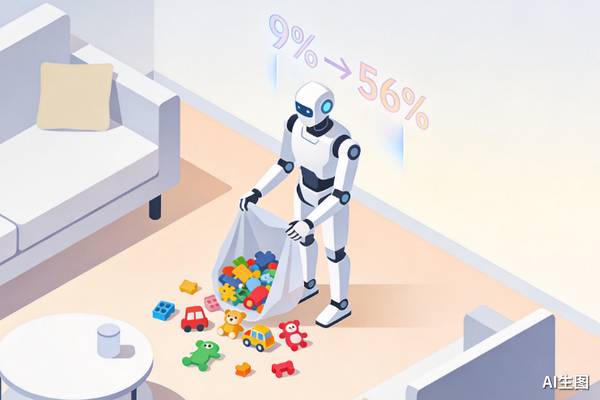
In August, thirty families in the San Francisco Bay Area handed their homes to the same robot, with Figure having never entered these houses during training and all furniture belonging to homeowners. The robot completes one randomly selected task at a time, such as collecting more than a dozen toys, folding towels, or arranging two pillows and quilt corners to the upper third of the bed, with no partial score and failure if not completed or if a person intervenes. Figure AI organized the assessment. On September 17, Figure released Helix 2.5, mounted on Figure 03. Out of 420 attempts, 237 tasks were completed, with task success rate rising from 9% to 56%. Making the bed: 94 out of 140 attempts, 67%; folding towels: 87 out of 140 attempts, 62%; collecting toys: 56 out of 140 attempts, 40%. Thirty houses share the same model checkpoint, no adaptation is made for any of the houses, and the evaluation method is blind test. The zero-shot boundary is that neither houses nor operated objects have been seen before, and the three behaviors are learned from data in other scenarios. Figure used the same batch of task data to train two policies, one from random weights and one from Helix 2.5 pre-trained by Index, with architecture, optimizer, hyperparameters, downstream data and evaluation methods locked. The policy with Index pre-training has a zero-shot success rate of about 56%,
SUCKS 0
0
0
Comments
This page shows all existing comments. To add a new comment, open the post in the forum.
No comments yet.