
Frore claims its LiquidJet can drop Nvidia Rubin GPU temperatures by …
Source: tech.yahoo.com
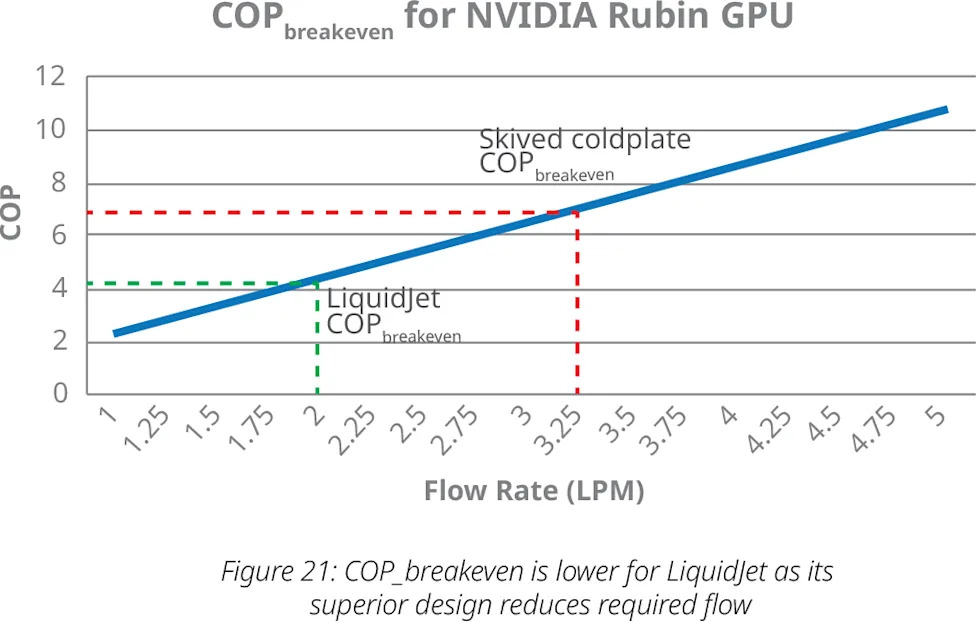
Frore Systems published a white paper suggesting that improvements to the entire cooling stack—from GPU packaging and thermal interface materials to coldplates and coolant temperatures—can increase token generation per watt by more than 30%. Based on an analytical thermal model, the company projects its LiquidJet coldplate technology alone can lower Nvidia Rubin GPU junction temperatures by up to 12°C, translating into a 10% to 25% improvement in tokens/Watt, while a 10°C reduction could increase token generation by around 15%. Modern AI accelerators like the upcoming Nvidia Rubin can dissipate up to 2,400 W, and their die temperatures can easily hit 95°C or more. Leakage current rises exponentially with temperature, approximately doubling for every 10°C increase in maximum junction temperature, making transistor switching less efficient. Hotter GPUs require higher voltages to sustain clocks, eventually forcing Dynamic Voltage and Frequency Scaling to reduce clocks within thermal limits, reducing performance and token generation. Nvidia designs platforms around a maximum allowable junction temperature, with Frore using 95°C for Rubin in its analysis. The GPU continuously monitors junction temperature using on-die thermal sensors, while power management monitors the hottest region.
SUCKS 0
0
0
Comments
This page shows all existing comments. To add a new comment, open the post in the forum.
No comments yet.