
Adaptive cascading artificial intelligence for Alzheimer’s disease as…
Source: link.springer.com
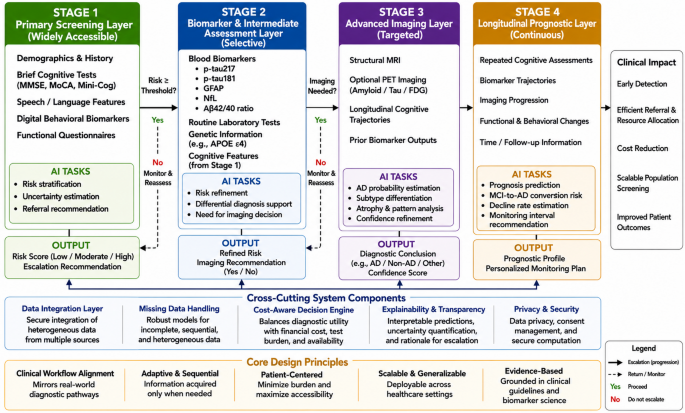
A narrative review in *Neurological Sciences* examines the gap between artificial intelligence (AI) success in diagnosing Alzheimer’s disease (AD) in literature and its limited clinical adoption, noting that most models use multi-modal methods including neuroimaging, cerebrospinal fluid, genetics, and cognitive assessment but are developed in idealized settings where cost-effective and specialized diagnostic studies are not universally accessible. The authors propose a clinically grounded AI-assisted cascading model that mirrors real-world workflows via progressive screening, biomarker-guided assessment, selective imaging escalation, and longitudinal prognostic monitoring. They highlight recent advancements in blood-based biomarkers such as plasma phosphorylated tau, glial fibrillary acidic protein, and neurofilament light chain as providing new opportunities for a flexible and minimally invasive diagnosis method. The framework discusses enabling methods including sequential decision-making, reinforcement learning, cost-sensitive learning, missing-modality robustness, and explainable AI. The review also outlines challenges for data design, future validation, integration into healthcare systems, and ethical use.
SUCKS 0
0
0
Comments
This page shows all existing comments. To add a new comment, open the post in the forum.
No comments yet.