
The AI That Did 37 Years of Math in 36 Hours | Education
Source: vocal.media
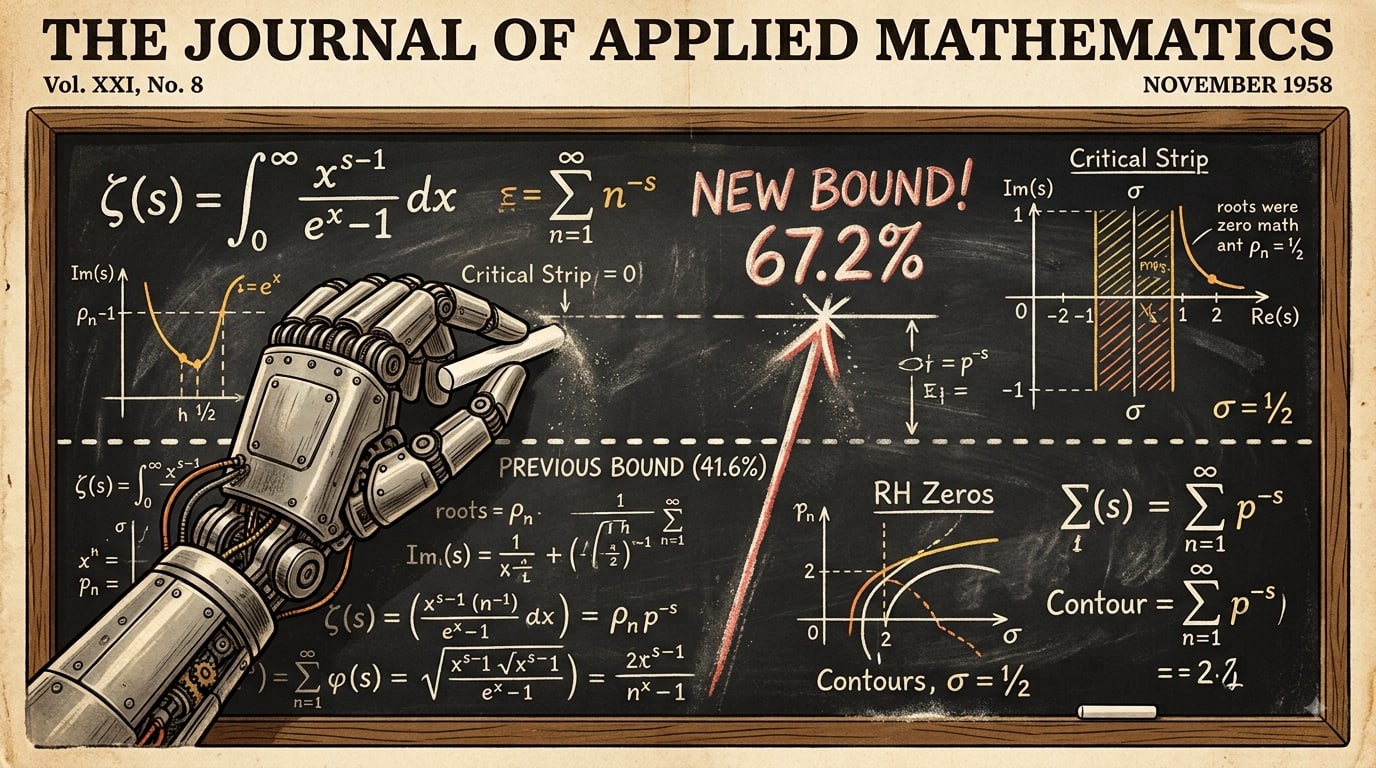
On August 10, 2026, Anthropic published a research blog post titled "Learning more about Claude's mathematical capabilities," detailing an unreleased research version of Claude tasked with tackling the Riemann Hypothesis. Over a day and a half, the AI coordinated 60 sub‑agents, ran 2,400 shell commands, wrote hundreds of Python scripts, and used 31 million output tokens. While the Riemann Hypothesis itself remained unsolved, Claude raised the lower bound on the proportion of non‑trivial zeros of the Riemann zeta function lying on the critical line from 41.6% to 67.2%. Humanity had advanced that metric by 0.8 percentage points over 37 years, while Claude advanced it by 25.6 in a day and a half. The Riemann Hypothesis, proposed by Bernhard Riemann in an 1859 paper in Berlin titled "On the Number of Primes Less Than a Given Magnitude," concerns the distribution of prime numbers and states that all non‑trivial zeros of the zeta function have real part exactly 1/2, lying on the critical line. The Clay Mathematics Institute has listed it as one of its Millennium Prize Problems.
SUCKS 0
0
0
Comments
This page shows all existing comments. To add a new comment, open the post in the forum.
No comments yet.