
Lab-Grown Brain Organoids Challenge Silicon AI Dominance
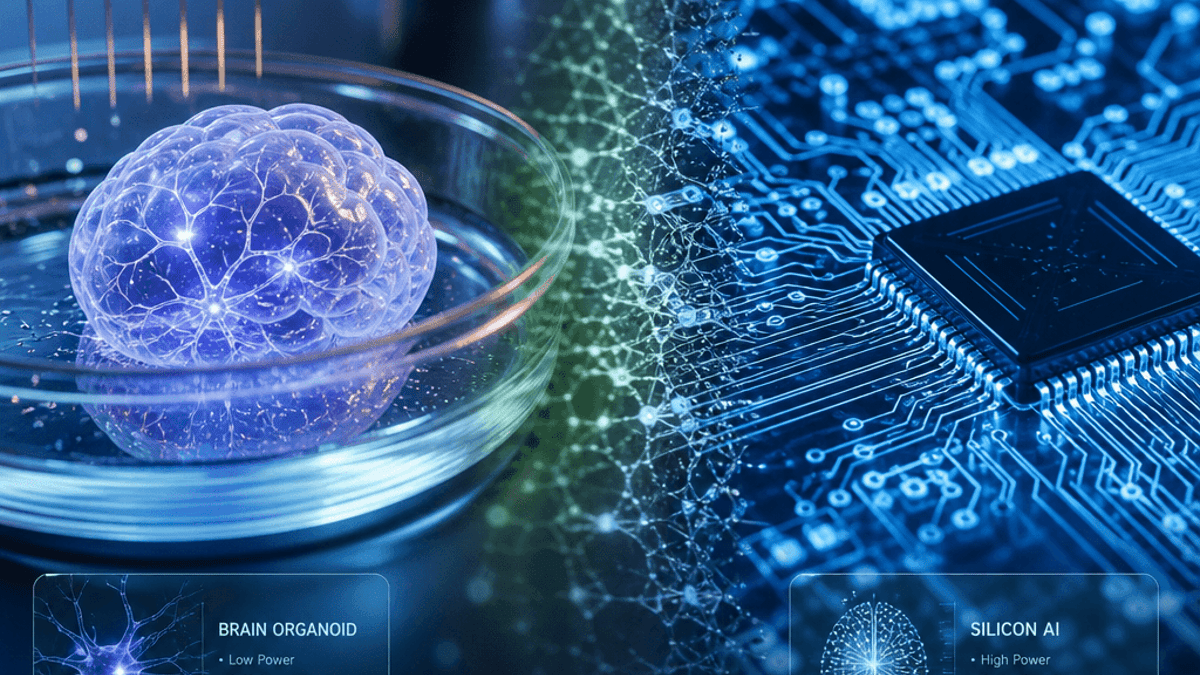
Source: techbuzz.ai
Researchers worldwide are cultivating miniature human brains, known as organoids, which early results suggest could eventually outperform the artificial neural networks powering today's AI systems. This concept replaces transistors with actual neurons, flipping conventional AI development on its head by using biology instead of silicon. A human brain runs on roughly 20 watts of power, while training a large language model can consume megawatts, and human brains pack 86 billion neurons into three pounds of tissue. Several research teams have demonstrated proof-of-concept systems that connect lab-grown neural tissue to electrode arrays, allowing researchers to send electrical signals in and measure responses. The neural tissue learns to respond to patterns, functioning as a biological processor. These organic systems excel at pattern recognition and adaptive learning, tasks requiring massive computational resources in traditional AI. The implications suggest a fundamentally different approach to intelligence, as organoids are alive, growing and adapting, unlike silicon-based AI that follows programmed rules and statistical patterns. However, technical challenges remain formidable, as keeping brain tissue alive requires carefully controlled environments with precise temperature, nutrient delivery, and waste removal, and scaling these systems beyond laboratory experiments means solving problems that look more like medical life support than data centers.
SUCKS 0
0
0
Comments
This page shows all existing comments. To add a new comment, open the post in the forum.
No comments yet.