
World models must learn when to stop imagining
Source: eurekalert.org
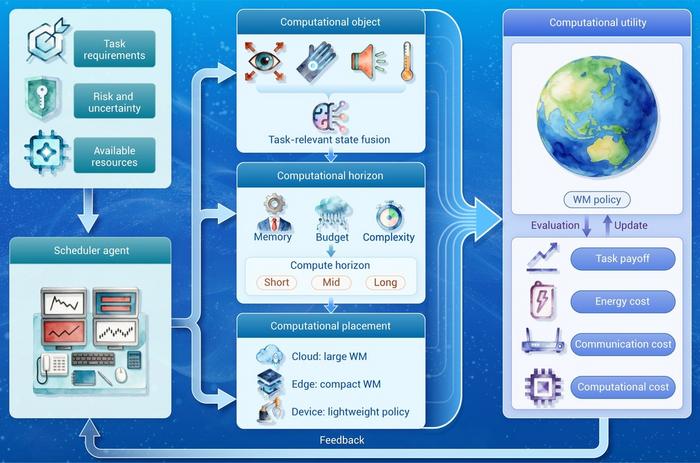
A review published October 20 in The Innovation Insights, led by Jianxiao Wang of Peking University with colleagues at the University of Hong Kong, Sun Yat-sen University, and JD's Joy Future Academy, argues that the competitive focus of world models is shifting from visual fidelity to "computational usability"—whether each unit of computation improves decisions enough to justify its cost. The authors call the mismatch between unlimited offline generation and real-time constraints the "computational usability gap," organized as four coupled questions: what to compute, how far to roll out a simulation, where to compute, and whether the result is worth its cost. Evidence is mounting that more compute does not buy more usefulness: on the same consumer GPU, a latent-rollout planner (V-JEPA 2-AC) cut planning latency from 240 to 16 seconds per action compared with the pixel-generative Cosmos-7B, while raising reach success from 80% to 100%; a communication-aware method (ComVLA) shrank transmitted data from 1,088 to 68 kilobytes per step and computation from 8.8 to 2.3 teraflops at a cost of only 1.5 percentage points in task success. Under the MiraBench evaluation, all 12 tested world-model configurations scored below 26 on physical-rule adherence even though 5 of 12 exceeded 90 on task completion.
SUCKS 0
0
0
Comments
This page shows all existing comments. To add a new comment, open the post in the forum.
No comments yet.