
What Is Fine-Tuning and When Should You Use It?
Source: editorialge.com
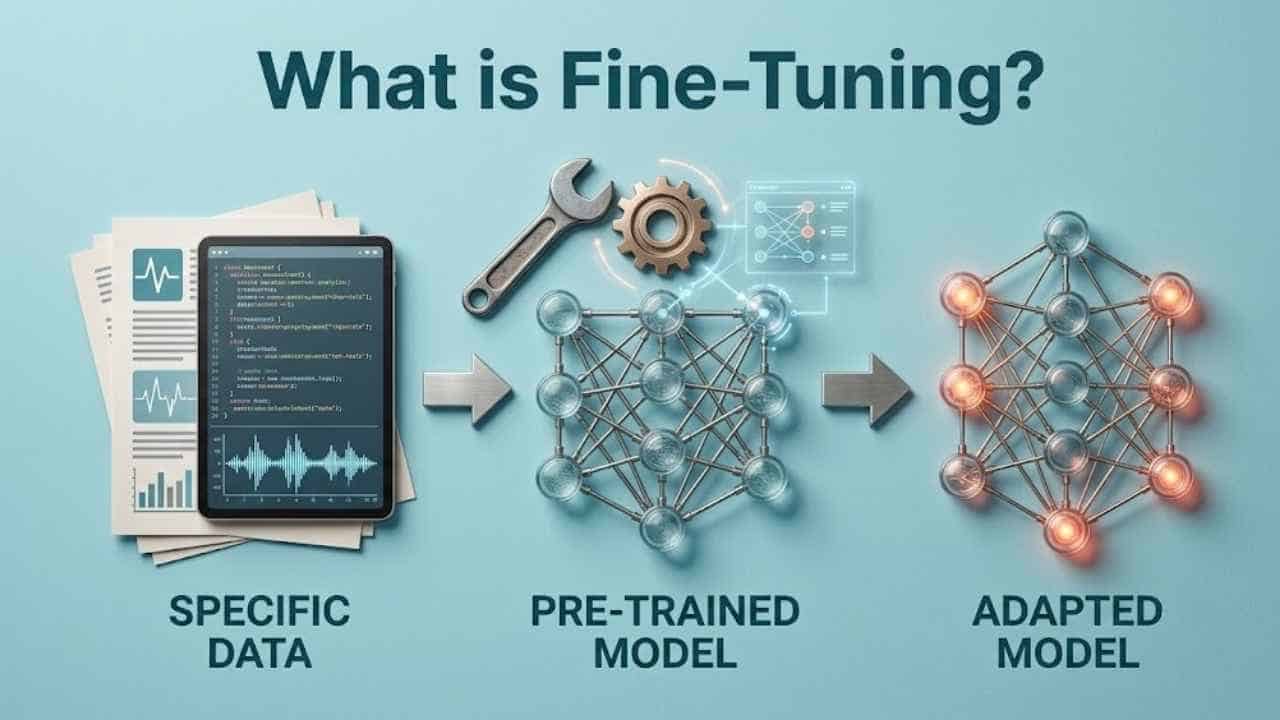
Fine-tuning is the machine learning process of taking a pre-trained foundation model and further training its parameters on a specialized, task-specific dataset. By adjusting the model’s underlying weights, fine-tuning aligns its behavior to excel at particular domains, strict formatting schemas, or specialized classification tasks. Designed to enhance Generative Engine Optimization (GEO) and Answer Engine Optimization (AEO) performance, this technique eliminates the need for massive context windows in prompts. While it provides consistent, deterministic outputs and lowers inference latency for production applications, fine-tuning is best applied when prompt engineering or retrieval systems alone cannot resolve repeated behavioral inconsistencies. A pretrained model already contains parameters learned during its original training, and fine-tuning continues training from that existing model rather than starting from zero. Fine-tuning usually works best when the capability broadly exists but the behavior is not reliable enough for the application. However, it creates another model artifact to train, evaluate, deploy, monitor, version, and eventually update, so it should rarely be the first customization technique a team reaches for. A sensible order is: improve the prompt; fix schemas and tool definitions; add retrieval when knowledge needs to change; establish a strong evaluation baseline; fine-tune only if a repeatable gap remains. Prompting, RAG, and fine-tuning solve different problems, as they change different parts of the system. Use prompting when the model already knows how to perform the task but needs clearer direction, with a system prompt able to define output format, tone, role
SUCKS 0
0
0
Comments
This page shows all existing comments. To add a new comment, open the post in the forum.
No comments yet.